


|
Getting your Trinity Audio player ready...
|
Cartier — The Antiquarian Visionary
If one house can be said to have defined the art of Egyptian Revival jewellery in the twentieth century, it is Cartier. While other maisons drew on Egyptian motifs as decorative vocabulary, Cartier — under the creative vision of Louis Cartier, grandson of the founder — did something unprecedented: he incorporated actual archaeological fragments into contemporary Art Deco settings, collapsing the distance between ancient and modern into a single, wearable object.
Louis Cartier was a serious collector of antiquities. He acquired Egyptian artefacts from specialist dealers in Paris, studied the major source books — the Description de l’Égypte and Owen Jones’s Grammar of Ornament — and built a personal collection of ancient faience, scarabs, and carved plaques that he displayed at his home on the rue Saint-Guillaume. His approach to Egyptian-inspired jewellery was not imitative but synthetic: he would take an ancient fragment and set it within a framework of platinum, diamonds, and coloured gemstones that was unmistakably Art Deco. The result was a new kind of object — neither a reproduction nor an abstraction, but a dialogue between millennia.

Platinum, diamond, faience, lapis lazuli.
Designed as an Egyptian fan, or flabellum, centering an ancient green glazed faience bust of the goddess Sekhmet, depicted with a solar disc and a uraeus (cobra) upon her head, set against a lapis lazuli sky twinkling with diamond stars bordered by a black enamel aureole and repeating diamond-set stylized lotus motif, all surmounting a stylized lotus blossom; set in platinum and 18 karat gold with a total of 11 single-cut and 89 old European-cut diamonds; the back of the brooch fitted with an 18 karat gold crook, a symbol of state power in Egypt when held by the pharaohs in conjunction with a flail, placed as the connecting support element for the faience relic, signed Cartier Londres.
The most characteristic Cartier creations of this period are the winged scarab brooches. A Scarab Brooch of 1924, made by Cartier London, centres a carved smoky quartz scarab with emerald eyes, flanked by wings of ancient Egyptian blue faience, set in gold and platinum with diamonds and enamel. It remains in the Cartier Collection, the maison’s permanent heritage archive. The pairing of this piece with an authentic ancient winged scarab amulet dating from 740–660 BC formed the centrepiece of the Past is Present: Revival Jewelry exhibition at the Museum of Fine Arts, Boston (2017–2018) — a visual juxtaposition that powerfully illustrated how Cartier bridged archaeological integrity with modern design.
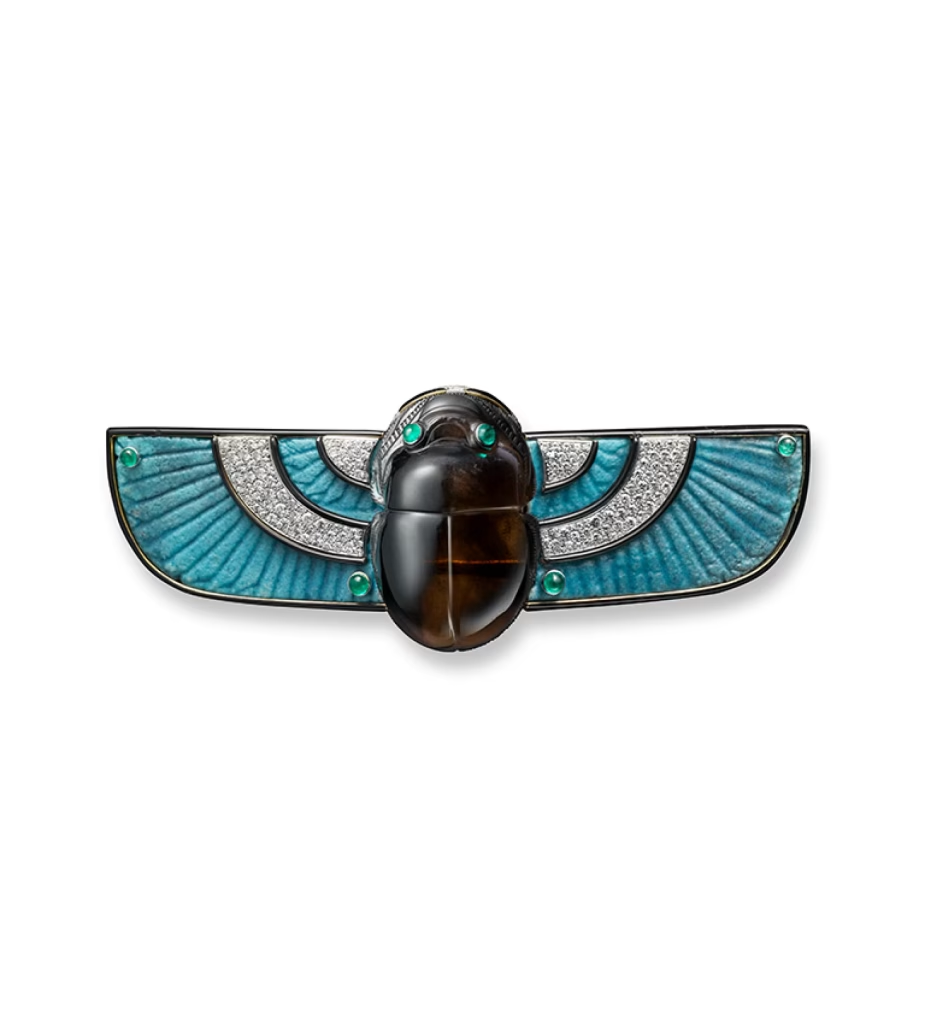
Gold, platinum, Ancient Egyptian faience, diamonds, emeralds, smoky quartz, enamel
The wings date from the second half of the first millennium BCE and come from the stock of apprêts. The term apprêts at Cartier referred to a stock of fragments from disassembled jewellery and objects, including ancient items from Persian, Indian, Chinese, and Egyptian art. Cartier Collection.

Two years later, in 1926, Cartier created a Scarab Belt Buckle Brooch for Linda Lee Porter, wife of the legendary American composer Cole Porter. This piece centred an ancient Egyptian faience scarab (also dating from 740–660 BC) in a geometric setting of baguette-cut diamonds and sapphires — a fusion of ancient relic and Art Deco precision. Linda Porter later commissioned a matching bracelet featuring a replica of the Eye of Horus, the ancient Egyptian symbol of protection and regeneration. Both pieces are documented in the Cartier Collection (Inv. CL 341 A26).


Among Cartier’s most spectacular Egyptian creations are two fan brooches, or flabella, made by Cartier London in 1923. One centred an ancient green glazed faience bust of the goddess Sekhmet, depicted with a solar disc and uraeus upon her head, set against a lapis lazuli sky twinkling with diamond stars and bordered by a lotus motif. It was sold at Sotheby’s in 2013 for $1,025,000 (illustrated above). The companion piece featured an inscribed ancient steatite plaque naming Mentuemhat, the Mayor of Thebes, within a similar semicircular diamond-set papyrus design. Both pieces were featured in The Illustrated London News in January 1924, in a special feature on the new Tutankhamun-inspired jewellery.

Cartier’s Egyptian ambitions extended beyond personal jewellery. The maison created an Egyptian Sarcophagus Vanity Case around 1925, fashioned in gold, platinum, engraved bone, diamonds, emeralds, sapphires, onyx, and enamel — a miniature work of art complete with its own mirror stand. Most remarkably, Cartier produced the Temple Gate Clock in 1927, inspired by the Gate of Khons at Karnak, one of the most recognisable structures in the Description de l’Égypte. Embellished with mother-of-pearl panels engraved with hieroglyphs, lapis lazuli inlays, enamelled gold, and carved coral bamboo handles, it was sold in 1929 and later offered at Christie’s in 1991. It has been exhibited at the Legion of Honor Museum in San Francisco as part of the Cartier & America exhibition — a testament to its enduring significance as one of the finest Art Deco objects ever made.


The Egypt mania did not end for Cartier in the 1930s. The maison created a “Halo” Lotus Tiara for the Begum Aga Khan in 1934, its lotus flower motifs rendered in the more monochromatic palette that characterised the later Art Deco period. And in the 1980s, Cartier returned to the theme with a gold “Tanis” scarab cuff bracelet-watch, now in the Cartier Heritage Collection — proof that the conversation between Cartier and ancient Egypt has never truly ended.

This is a fine example of 1920s Egyptomania. Lotus flowers sit above a line of zigzag motifs which can be detached and worn alone as a bandeau. The tiara was owned by Princess Andrée Aga Khan, third wife of Aga Khan Ill, who was a descendant of the Fatimid caliphs of Egypt.
Cartier London, 1934. Owned by Princess Andrée Aga Khan, wife of Sir Sultan Mahomed Shah Aga Khan Ill
Diamonds, platinum
Cartier Collection – HO 10 A34. Photographed at the Victoria & Albert Museum, London – ‘Cartier’ exhibition.
(c) Claudia Carletti Camponeschi.

‘Tanis’ | A yellow gold and stainless steel cuff watch | Circa 1990. (c) Sotheby’s.
Van Cleef & Arpels — The Colour Alchemists
Where Cartier incorporated genuine antiquities, Van Cleef & Arpels chose a different path. The maison’s Egyptian-inspired pieces, created between 1923 and 1925, translated the imagery of the pharaohs through the lens of Art Deco geometry and an extraordinary chromatic palette.
The most celebrated piece is the Egyptian Pattern Bracelet of 1924 — a band bracelet in which an ornamental repertoire inspired by ancient Egypt unfurls across a background of pavé-set diamonds. At its centre, a winged female figure set with rubies and onyx hair spreads her ruby, sapphire, and emerald wings. She is flanked by two registers featuring a dog on one side and a chimeric creature with a falcon’s head on the other, both seated on a pedestal of onyx flanked by a crook and flail — the attributes of the pharaohs. The bracelet was executed by the Rubel Frères workshop, one of the finest independent ateliers supplying the Place Vendôme maisons, and remains in the Van Cleef & Arpels Heritage Collection.
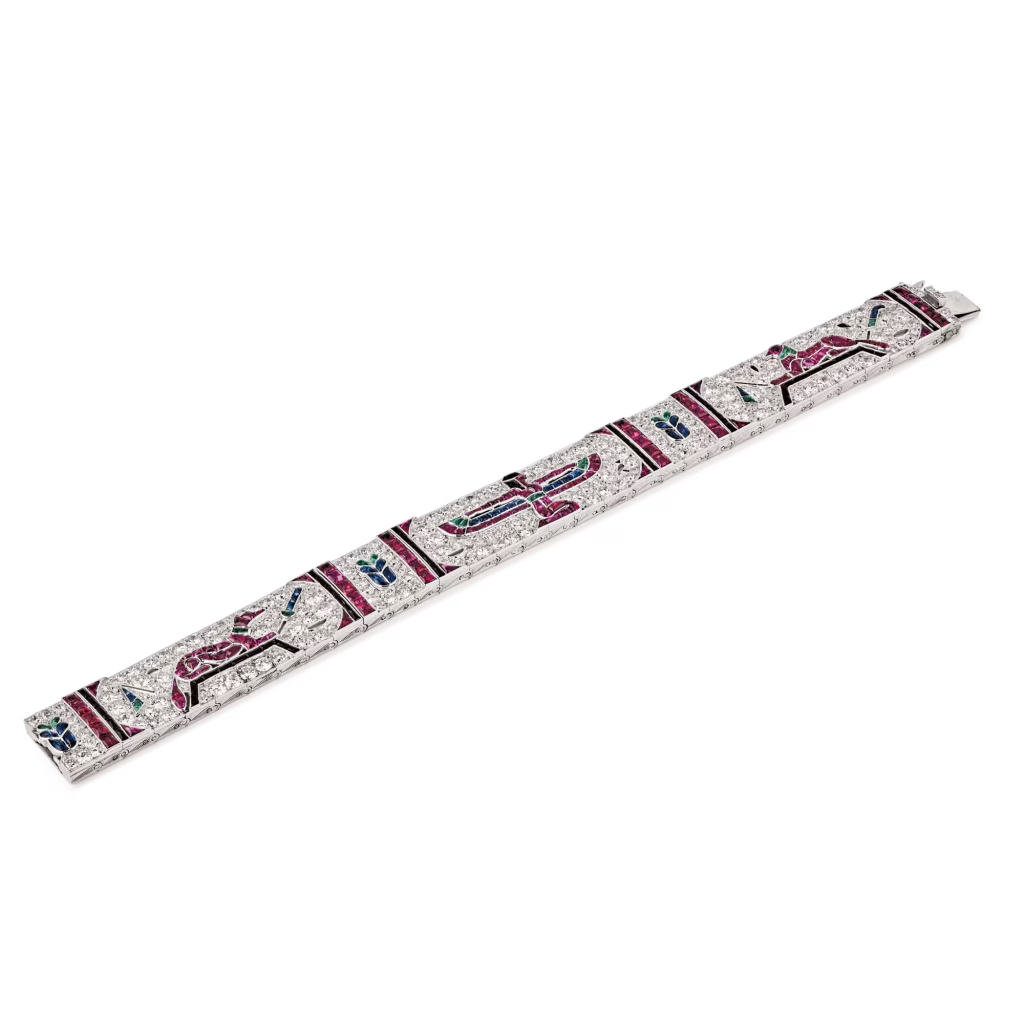
Van Cleef & Arpels also created an Egyptian Revival Pendant Sautoir in 1924, a striking piece in diamonds, emeralds, rubies, and silver depicting a falcon — the god Horus — in full Art Deco stylisation. It was sold at Christie’s and is currently in a private collection. Additional bracelets and brooches from the 1923–1925 period depicted hieroglyphics, sphinxes, amphorae, bulls, ostrich feathers, and lotus flowers, rendered in buff-top cabochon rubies, sapphires, emeralds, and onyx — the bold chromatic contrasts that defined the maison’s approach.

What distinguished Van Cleef & Arpels from Cartier was the treatment of colour. Rather than embedding archaeological fragments, Van Cleef used the buff-top cabochon — a stone with a flat top and rounded underside — to achieve the dense, saturated blocks of colour that characterised ancient Egyptian inlay work. The effect was not archaeological but painterly: the jewels read as miniature canvases in which Egyptian deities and lotus blooms were rendered in gem rather than pigment.
Lacloche Frères — The Storytellers
Among the most distinctive interpreters of Egyptomania were the Lacloche brothers — Fernand, Jacques, Jules, and Léopold — whose Paris-based maison, established in 1892 at the rue de la Paix, became renowned for its oriental and Egyptian-inspired creations during the 1920s.
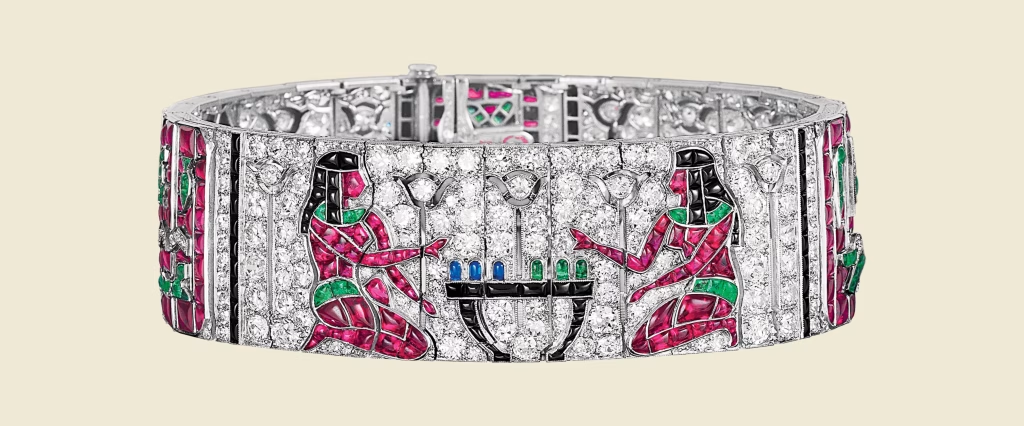
Lacloche Frères adopted a unique approach to Egyptian motifs: they laid out their compositions in what scholars have described as a “comic strip format,” depicting Egyptian scenes, symbols, and hieroglyphs in sequential narrative across bracelets, earrings, vanity cases, and evening bags. Where Cartier sought archaeological depth, and Van Cleef & Arpels pursued chromatic abstraction, Lacloche told stories — miniature visual narratives in rubies, sapphires, emeralds, onyx, and diamonds set in platinum.
The most celebrated Lacloche Egyptian piece is a bracelet of around 1925, set with diamonds, turquoise, sapphires, mother-of-pearl, black pearls, smoky quartz, and tourmaline in gold and platinum. It was exhibited at the Cooper-Hewitt, Smithsonian Design Museum in New York as part of The Jazz Age: American Style in the 1920s exhibition in 2017. The bracelet is currently in a private collection.

A related Egyptian Revival bracelet in diamonds and coloured stones (c. 1925) and an Egyptian Revival jadeite, gem-set, and diamond brooch (c. 1925) have appeared at Sotheby’s. In 1925, Lacloche Frères was awarded the Grand Prix at the Exposition Internationale des Arts Décoratifs et Industriels Modernes in Paris — the landmark exhibition from which Art Deco takes its name.

(c) Sotheby’s, 2014.

A Rare and Important Colored Stone and Diamond Bracelet | Lacloche Frères. (c) Sotheby’s, 2022.

Boucheron — The Colourist and the Serpent
Boucheron’s engagement with Egyptomania operated on two distinct levels — one visible in a single landmark creation, the other woven into the very identity of the maison.
The most significant Egyptian-inspired jewel was a corsage ornament created specially for the 1925 Paris Exposition, fashioned in the form of lotus leaves embellished with lapis lazuli, coral, and jade. Its form and colours are unmistakably Egyptian in inspiration — the lotus, sacred symbol of creation and rebirth, rendered in the exact chromatic register of the pharaohs’ treasures. Rather than reproducing literal motifs or narrative scenes, Boucheron absorbed the Egyptian influence at the level of principle: the ancient belief that specific colours carried specific powers. Lapis lazuli was the colour of the heavens; coral evoked the protective warmth of the sun; jade signified renewal. The corsage ornament translated these associations into a thoroughly modern jewel.

But the deeper Egyptian thread at Boucheron lies in the serpent. In 1888, Frédéric Boucheron — the maison’s founder — created a snake necklace for his wife Gabrielle as a token of love and protection before departing on a long journey. The symbolism was ancient and deliberate: in Egyptian belief, the serpent was the supreme protector. The uraeus cobra on the pharaoh’s crown spat fire at his enemies; the rearing asp on Cleopatra’s diadem signified her divine authority. By choosing the serpent for his most intimate jewel, Boucheron was drawing — consciously or not — on a symbolic tradition that stretched back three thousand years.

The serpent became the maison’s emblem. It appeared in brooches, rings, and bangles throughout the late nineteenth and early twentieth centuries, and was formally launched as the Serpent Bohème collection in 1968 — a line that has been continuously reinterpreted ever since and remains one of Boucheron’s most recognisable signatures. The serpent even coils around the letter B in the maison’s monogram. In this sense, Boucheron’s relationship with Egyptomania was never a passing fashion — it was structural, woven into the house’s identity at the level of its founding mythology.
Cleopatra, Elizabeth Taylor, and Bulgari: When Cinema Met Jewellery
If the 1920s were the decade in which Egyptomania conquered the jeweller’s workshop, the 1960s were the decade in which it conquered the silver screen — and in doing so, forged one of the most iconic partnerships in the history of jewellery.
The precedent had been set decades earlier. Cecil B. DeMille’s The Ten Commandments (1923) had dazzled audiences with grandiose Egyptian sets, and his 1934 Cleopatra, starring Claudette Colbert, had brought the legendary queen to Hollywood with sumptuous costume design. Sarah Bernhardt had performed as Cleopatra on the Parisian stage at the turn of the century, draped in jewels that blurred the line between theatrical prop and genuine adornment. By the mid-twentieth century, Egypt had become cinema’s most reliable source of visual spectacle.

Publicity photo by Paul Hesse.

But nothing prepared the world for Joseph L. Mankiewicz’s Cleopatra of 1963.
The film, shot at Cinecittà Studios in Rome, was the most expensive production ever mounted. Elizabeth Taylor, then the most famous woman in the world, starred as the Egyptian queen. The production required sixty-five costume changes for Taylor alone, each accompanied by elaborate jewellery — from towering headdresses to statement collars and serpent armbands. The costume jewellery was designed by Joseff of Hollywood, and it remains some of the most spectacular ever created for cinema.

But it was what Taylor wore off screen that would prove more consequential for the history of jewellery.
During the filming in Rome, Taylor — already a legendary collector of jewels — frequented the Bulgari boutique on the Via dei Condotti. She would later describe visiting Bulgari as her favourite Roman pastime. And it was during this period that she was photographed on set wearing a Bulgari Serpenti bracelet-watch: a gold Tubogas coil with a diamond-pavé snake head and emerald eyes, the timepiece concealed within the serpent’s mouth.

Photo La Presse and courtesy of Bulgari.
From: theadventurine.com
The photograph became one of the most reproduced images in jewellery history. The mystery of who had purchased the watch — Taylor herself? Her then-husband Eddie Fisher? Her co-star and lover Richard Burton, in an art-mirrors-life echo of Antony and Cleopatra? — only added to its allure. As Amanda Triossi, the consultant who helped form Bulgari’s permanent collection, has noted, the watch was sold in 1962, but no record accounts for who purchased it.
What matters, though, is what the image achieved. It fused the ancient symbolism of the serpent — the uraeus cobra on Tutankhamun’s golden mask, the protective asp of Cleopatra — with the glamour of modern celebrity, the craft of Italian goldsmithing, and the visual power of cinema. The Serpenti design, which Bulgari had first created in the 1940s inspired by serpents in Greco-Roman mythology, was transformed overnight from a connoisseur’s piece into a global icon.

The connection runs deeper than fashion. In ancient Egypt, the serpent was a symbol of royalty and divine protection: the uraeus — the rearing cobra — adorned the pharaoh’s crown and was believed to spit fire at the king’s enemies. Cleopatra, according to legend, chose death by the bite of an asp. And Bulgari’s Serpenti, coiling around Taylor’s wrist as she played the queen on screen, completed a symbolic circle that stretched from the tombs of the Valley of the Kings to the sound stages of Cinecittà.
Taylor’s relationship with Bulgari deepened over the years. For her thirty-first birthday, celebrated on the Cleopatra set in 1963, she received a magnificent Colombian emerald and diamond brooch from Bulgari. When she and Burton married in 1964, he commissioned Bulgari to create a matching emerald necklace. In 2010, near the end of her life, Paolo Bulgari presented her with a new Serpenti watch inscribed “To Dame Elizabeth, with gratitude” — a tribute to the woman who had done more than anyone to make the serpent bracelet an emblem of modern luxury.
Taylor’s Cleopatra Serpenti bracelet-watch was later sold at Christie’s in December 2011 for $974,500.
The Modern Revival: Egyptomania in the Twenty-First Century
One might have expected Egyptomania to exhaust itself — a century of creative borrowing from a single archaeological source would seem to leave little unexplored. And yet, the twenty-first century has seen a remarkable resurgence of Egyptian-inspired jewellery, driven not by nostalgia but by a genuine artistic engagement with the symbolic and material vocabulary of the pharaohs.
The most intellectually ambitious contemporary exploration came from Hemmerle, the Munich-based jeweller, with their “Revived Treasures” collection of 2018, created to celebrate the house’s 125th anniversary. The collection was deeply personal: Yasmin Hemmerle, who runs the house alongside her husband Christian and his parents Stefan and Sylveli, was born in Cairo. A family visit to the Egyptian Museum — where they saw Tutankhamun’s treasures up close — ignited the project.

Diamonds – faiences – bronze – white gold.
“Revived Treasures” comprised twenty-four unique creations, sixteen of which incorporated authentic ancient Egyptian artefacts that had been acquired from specialist dealers and galleries around the world over the previous decade. A set of faience amulets from the Old Kingdom Period (2200–2500 BC), representing the Sons of Horus — the gods who personified the Canopic jars accompanying the dead into the afterlife — were framed within temple-like structures of bronze studded with diamonds, to be worn as earrings.
Sacred scarabs from the New Kingdom and Third Intermediate Period (1350–1000 BC), engraved on the reverse with hieroglyphics, were set into earrings alongside diamonds. And a faience from the Amarna Period of the 18th Dynasty (1352–1336 BC) — the very era of Akhenaten, Tutankhamun’s heretic father — was returned to its original purpose as a necklace, featuring an emerald and sapphires hung on a flexible strap of hand-hewn agate beads knitted in the round over silk.

Scarabs – diamonds – bronze – white gold

What distinguished Hemmerle’s approach from the Art Deco masters was the use of unconventional materials — bronze, aluminium, blackened silver, copper, pock wood — alongside precious stones. The ancient faience amulets were given space within their settings, their natural decay and patina celebrated as evidence of the passage of time. Select pieces from Hemmerle’s broader body of work have entered the collections of the Metropolitan Museum of Art, the Victoria and Albert Museum, and the Cooper-Hewitt, Smithsonian Design Museum.
Lydia Courteille, the Parisian jeweller known for her narrative, historically inspired collections, created bracelet cuffs in the early 2000s called “Gala Ma Muse,” designed around the Egyptian Eye of Horus. The pieces were a fusion of Egyptomania and Surrealism — Gala being the wife and muse of Salvador Dalí — jewels that demonstrated how Egyptian symbolism could be layered with entirely different cultural references to create something new and unexpected.

David Webb, the American jeweller, had anticipated this kind of creative freedom decades earlier. In the 1960s, Webb created an “Eye of Horus” brooch featuring an ancient Egyptian relic eye in lapis lazuli set in 18K gold — a piece that brought the Egyptian Revival to the bold, sculptural aesthetic of mid-century American jewellery design.

In 2022, Messika launched “Beyond the Light”, a high jewellery collection inspired by the hieroglyphics and mythologies of ancient Egypt. The pièce de résistance was the “Akh-Ba-Ka” suite, whose name derives from the three components of the Egyptian soul. Fifteen exceptional D-flawless diamonds — created from a single 110-carat rough stone that Valérie Messika’s father had purchased just before lockdown in March 2020 — were set into winged scarab-inspired forms. The central necklace featured a 33-carat cushion-cut diamond; the winged ring held an 11.81-carat round brilliant. Transformable and technically audacious, the suite demonstrated that Egyptomania could drive innovation, not merely decoration.

Chanel’s Métiers d’Art 2018/2019 collection reimagined ancient Egypt in haute couture and jewellery: oversized gold cuffs, scarab-adorned necklaces, and statement collars reminiscent of Cleopatra’s legendary style.

And in 2025, on the centennial of the landmark Exposition from which Art Deco takes its name, Van Cleef & Arpels placed its 1920s Egyptian-inspired creations at the heart of a major heritage exhibition — returning the 1924 Egyptian Pattern Bracelet to the spotlight a full century after it was first conceived, and reminding the world that the visual language of the pharaohs remains as potent as ever.
The Immortality of Adornment
There is a profound irony at the heart of this story. The pharaohs believed that jewels could protect the soul on its journey to eternal life — that the right combination of gold, lapis lazuli, and carnelian, placed in the right position on the body, could shield the dead from the dangers of the underworld. To modern eyes, this belief may seem distant, even exotic.
And yet, the jewellers who have returned to Egypt again and again — from Castellani and Giuliano in the nineteenth century, through Cartier and Van Cleef & Arpels in the Art Deco explosion, to Hemmerle and Messika in our own time — have been drawn by something remarkably similar. They have recognised in the Egyptian tradition a principle that transcends any single culture or era: the idea that a jewel is not merely an object of beauty but a carrier of meaning. That colour can speak. That form can protect. That adornment is, at its deepest level, an act of faith — a declaration that beauty matters, that symbols endure, and that the things we wear upon our bodies say something about who we are and what we believe.
The boy-king who was meant to be forgotten has become the most remembered pharaoh in history. And the golden amulets that were placed upon his body to guide him through the afterlife have, in a sense, achieved their purpose — not by protecting Tutankhamun in the Egyptian underworld, but by ensuring that the language of his jewels would never die.
From Napoleon’s scarab ring to Bulgari’s Serpenti, from the tomb of a forgotten king to the ateliers of the Place Vendôme and the Maximilianstraße, Egyptomania endures. It endures because it was never merely a fashion. It was, and remains, a way of understanding what jewellery is for.
This is Part II of “Egyptomania and the Language of Jewels.” Part I traces the origins of the West’s fascination with Egyptian jewellery — from Napoleon’s scarab ring and the Victorian obsession with mourning symbolism, through the workshops of Castellani, Giuliano, and Tiffany, to the moment Howard Carter unsealed a forgotten tomb and changed the language of adornment forever. Read Part I here.
Discover more from HIGH JEWELLERY DREAM
Subscribe to get the latest posts sent to your email.
0 comments on “Egyptomania and the Language of Jewels”