


|
Getting your Trinity Audio player ready...
|
Opening on April 11, 2025, at The King’s Gallery, Buckingham Palace, The Edwardians: Age of Elegance offers a rare window into the opulent world of Britain’s royal family during the early 20th century.


© Royal Collection Enterprises Limited 2024 | Royal Collection Trust.
This major exhibition, the first of its kind by the Royal Collection Trust to explore the Edwardian era, showcases over 300 items—nearly half displayed for the first time. Among the paintings, photographs, and decorative objects, the jewellery stands out as a testament to the era’s craftsmanship and the personal stories of two royal couples: King Edward VII and Queen Alexandra, and King George V and Queen Mary.


The Edwardian period, roughly spanning the reign of Edward VII from 1901 to 1910 and extending into the early years of George V’s rule, was a time of transition. Britain hovered between Victorian restraint and modern innovation, while Europe inched toward the cataclysm of World War I.
Amid this backdrop, the royal family embraced a lifestyle of glamour and sociability, and their jewellery collections reflected both their status and their tastes. Curator Kathryn Jones notes that the exhibition reveals “a golden age of style and glamour,” but also a deeper need to preserve a vanishing way of life through objects of beauty and meaning.
Alexandra’s Dagmar Necklace: A Royal Wedding Treasure
One of the exhibition’s highlights is Queen Alexandra’s Dagmar necklace, a wedding gift from the King of Denmark when she married Albert Edward (later Edward VII) in 1863.


Named after the Danish princess Dagmar of Bohemia, this piece is a striking example of mid-19th-century design that evolved with Alexandra’s impeccable style. Crafted in gold and set with pearls and diamonds, the necklace features a cross pendant—a nod to Denmark’s Christian heritage.
Alexandra, dubbed by Vogue as “the legitimate head of fashion throughout the British dominions,” wore such pieces to establish a new, vibrant court distinct from Queen Victoria’s mourning-shrouded reign. Visitors can expect to see how this necklace bridged personal sentiment and public display, a recurring theme in Edwardian royal jewellery.
Mary’s ‘Love Trophy’ Collar: A Debut in Diamonds
Equally captivating is Queen Mary’s ‘Love Trophy’ Collar necklace, making its public debut at The King’s Gallery. This intricate piece, likely commissioned or gifted during her time as Princess of Wales or early in her queenship, showcases the Edwardian penchant for elaborate diamond work.


The collar design, with its interwoven motifs symbolizing love and unity, reflects the technical precision of the period’s jewellers. Mary, known for her meticulous collecting, paired such items with her famously upright posture, turning jewellery into a statement of regal authority. Its inclusion in the exhibition underscores her role in carrying forward the Edwardian aesthetic into the 20th century.
Fabergé’s Mastery: From Cigarette Cases to Eternal Love
The exhibition also shines a spotlight on the royal family’s love affair with Carl Fabergé, the Russian jeweller whose works became synonymous with luxury. Over 20 Fabergé items will be on display, including a blue enamel cigarette case adorned with a diamond-encrusted snake biting its own tail—a gift to Edward VII from his mistress, Mrs George Keppel, in 1908.


The snake, a symbol of eternal love, adds a layer of intimacy to this otherwise ostentatious object. Alexandra’s sister Dagmar, married to the Tsar of Russia, introduced the family to Fabergé, sparking a collecting passion that produced miniature masterpieces like this one.
Another notable piece is a Cartier crystal pencil case set with diamonds and rubies, also debuting here, blending utility with extravagance in true Edwardian fashion.


Beyond the Jewels: A Broader Canvas
While the jewellery anchors the exhibition’s allure, it sits within a rich tapestry of Edwardian life. Visitors will encounter paintings by John Singer Sargent and Philip de László, capturing the era’s sartorial splendour and cluttered recreations of royal residences like Marlborough House and Sandringham House, where such treasures were displayed.


A photograph of Edward VII in knightly costume from Queen Victoria’s 1897 Diamond Jubilee ball hints at the theatricality of their social world, while Alexandra’s own Kodak snapshots reveal a personal fascination with photography—a modern hobby for a traditional monarchy.


The royal couples’ global travels also left their mark on the collection. An Egyptian scarab brooch, given to Alexandra by Edward after his 1863 Middle East tour, showcases how jewellery doubled as a travel memento and diplomatic gift.


Similarly, an embroidered hanging from their 1901 Australia visit reflects the tangible ties forged across the empire.


The End of an Era
The exhibition’s narrative arc closes with the sombre shift brought about by World War I. The glitz of the Edwardian age gave way to a more restrained monarchy under George V and Mary, a transition mirrored in their later acquisitions—like Olive Edis’s (Britain’s first official female war photographer) wartime landscapes. Yet the jewellery remains a vivid link to that earlier, fleeting moment of elegance.


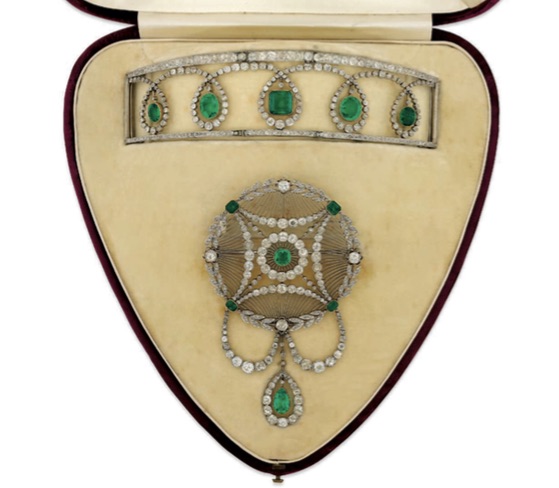

Running until November 23, 2025, The Edwardians: Age of Elegance offers more than a display of royal finery. It’s a journey through a pivotal era, told through objects that dazzled then and still resonate now.
For jewellery enthusiasts, the chance to see Alexandra’s Dagmar necklace, Mary’s ‘Love Trophy’ Collar, and Fabergé’s intricate creations up close is reason enough to visit.
For more details, visit www.rct.uk or call +44 (0)30 3123 7301.