


|
Getting your Trinity Audio player ready...
|
In the language of high jewellery, few words carry as much weight as “eclecticism.” For most maisons, it suggests a willingness to borrow — a decorative openness, perhaps, or a season’s flirtation with the unfamiliar. For Bvlgari, it means something altogether more fundamental. Eclecticism is not what this house does occasionally; it is what this house is. And with Eclettica, the Roman jeweller’s latest and most ambitious high jewellery collection, that identity is named, claimed, and elevated into a creative manifesto.


The Roots of Roman Eclecticism
To understand why this matters, one must look backwards before looking at the jewels themselves. When Sotirio Bulgari — a Greek silversmith from Paramythia, in Ottoman Epirus — arrived in Rome in 1881 and opened his first shop three years later, the European jewellery world was still firmly under the spell of the French school. Platinum, geometric precision, restrained palettes: the vocabulary was Parisian, and everyone spoke it. The early Bvlgari creations of the 1920s dutifully followed this language, producing Art Déco designs in platinum and diamonds that, while technically accomplished, could have come from any distinguished atelier on the Place Vendôme.
The rupture came a generation later. In the 1950s, Sotirio’s grandsons — Paolo, Gianni, and Nicola Bulgari — decisively abandoned Parisian convention. Working from the family’s single shop on Via Condotti, at the foot of the Spanish Steps, they forged a style that was unmistakably Roman: bold cabochon cuts inspired by the cupolas of the city’s churches, audacious combinations of precious and semi-precious stones that would have scandalised the conservative Parisian taste, and a preference for the warm luminosity of yellow gold over the cooler austerity of platinum.

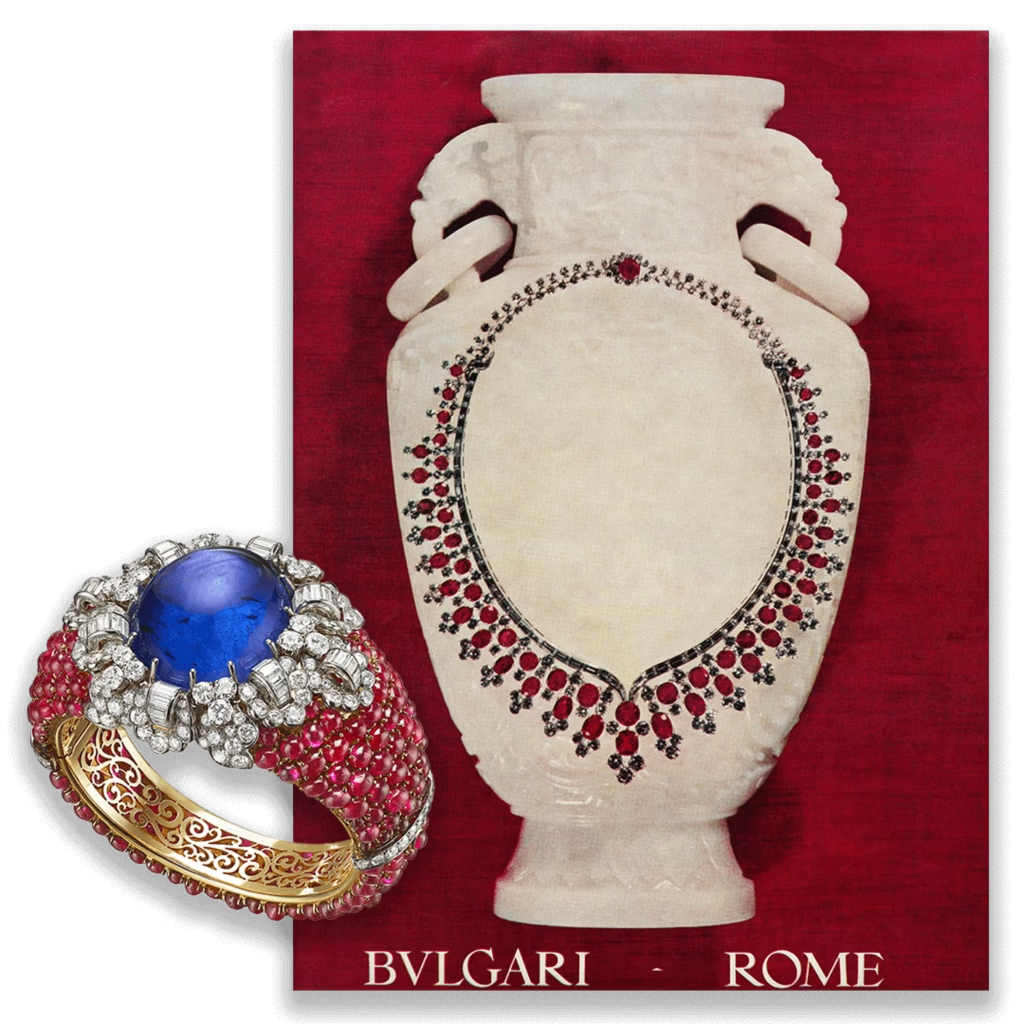
This was the aesthetic revolution that made Bvlgari the jeweller of the dolce vita — the house that dressed Elizabeth Taylor, Sophia Loren, Ingrid Bergman, and Anna Magnani with jewels that felt as sensuous and unapologetic as Rome itself.
It was also the moment when eclecticism ceased to be merely a tendency and became a method. From the 1970s onwards, Bvlgari drew freely from Mughal carved emeralds, Japanese lacquer, Egyptian motifs, ancient Roman coins, and architectural geometries — fusing references that, in lesser hands, would have clashed, but which the house consistently resolved into a coherent, distinctly Italian harmony. The first Serpenti bracelet-watches had already appeared in the 1940s; now the serpent became a vessel for every conceivable artistic influence, its sinuous form proving endlessly adaptable.
Painting as Precious Palette
With Eclettica, Bvlgari channels this legacy into its most ambitious high jewellery statement to date: over 150 creations, 15 transformable pieces — the highest number ever presented by the house — and nine extraordinary jewels designated as Capolavori, exploring three artistic territories: painting, sculpture, and architecture.
The dialogue with painting finds its most dramatic expression in the Seres Scarf necklace, a creation that translates the geometries and textures of Art Déco fabric into a jewel that drapes on the body like woven cloth.


Conceived in white gold and composed of more than 1,180 individually modelled and assembled elements — requiring over 1,600 hours of handwork — the necklace flows like an interlaced ribbon, its sapphires and emeralds creating a chromatic weave that evokes the bold female silhouettes of Tamara de Lempicka. A removable brooch, centred on a sculptural sugarloaf sapphire of 31.90 carats from Sri Lanka, can be positioned freely along the necklace’s length — an expression of Bvlgari’s signature transformability taken to new heights of creative freedom.


The painterly theme continues in the Secret Garden necklace, conceived as a gemstone canvas evoking the most intimate Roman courtyards at dusk. At its heart sits a rarissimo Padparadscha sapphire of 26.65 carats from Sri Lanka — a stone whose delicate equilibrium between pink and orange makes it one of the most coveted varieties in the gemological world.

Lucia Silvestri, Bvlgari’s Jewellery Creative Director, has described this particular stone as a long-pursued love. The composition surrounding it — baguettes paired with round cuts, onyx inlays, violet sapphires alternating with cabochon emeralds — has been meticulously calibrated to serve the stone’s unique personality.
In the Incontro Segreto ring, it is not an abstract painterly quality that provides the inspiration but a specific masterpiece: Francesco Hayez’s Il Bacio (1859), arguably the most iconic painting of the Italian Risorgimento.


Hayez’s canvas, which hangs in the Pinacoteca di Brera in Milan, depicts a medieval couple locked in a passionate farewell kiss, their garments coloured in the blues, reds, and greens of the French and Italian flags — a coded tribute to the Franco-Piedmontese alliance that would lead to Italian unification. Bvlgari’s ring reimagines the painting’s emotional intensity through the toi et moi motif — a signature the house has employed since the 1980s — pairing a 7.85-carat antique pear-shaped diamond with a 5.42-carat Colombian emerald of exceptional clarity. Two stones, each with its own history, drawn together like the figures on Hayez’s canvas.
Sculpture as Living Form
The Serpenti icon — Bvlgari’s most enduring and versatile motif, born in the 1940s — undergoes a series of radical sculptural reinterpretations in Eclettica.
The Serpenti Infinia bracelet transforms the serpent into a prism of infinite reflections. At its centre sits a diamond cut exclusively for this creation: under Lucia Silvestri’s direction, a flat rough crystal was sculpted into a unique 7.49-carat stone, shaped to follow the anatomy of the serpent and to amplify the visual depth of the gem far beyond what its carat weight might suggest. The setting is a masterwork of individual craftsmanship — each scale incised separately to preserve curvature, movement, and light — with 1,385 of the total 1,800 working hours dedicated exclusively to cutting the diamonds.

The Serpenti Illusio necklace plays with perception itself. The serpent is revealed not through solid form but through the negative space between its sinuous contours — an approach that reinterprets classical sculpture through the lens of abstract spatial art. What first appears as a hypnotic geometry of diamonds gradually unveils the serpent’s silhouette, shaped like a contemporary bas-relief and enriched with emerald accents and onyx inserts. At its core, a 14.01-carat antique cushion-cut sapphire from Madagascar, mounted on the diagonal, anchors the composition. Hand-crafted from 235 elements over 1,300 hours, this is jewellery as optical illusion.

The Serpenti Spira bracelet takes its cue from the monumental symmetry of Roman Corinthian columns. A sinuous serpent body unfurls in unbroken continuity from a flexible, claspless white gold base — its heart a 5.08-carat Fancy Vivid Yellow pear-shaped diamond of extraordinary homogeneity and rarity, amplified by pavé diamonds and onyx details. The modular structure — 340 elements, 1,500 hours of craftsmanship — conceals a proprietary Bvlgari mechanism, while the hidden surfaces are entirely set with diamonds: an expression of perfection invisible to the eye but absolute in its commitment.

Heritage Made Monumental: The Serpenti Imperial Heart
If one creation in Eclettica compels the jewellery historian to pause, it is the Serpenti Imperial Heart necklace — and the reason lies in its centrepiece. The 30.75-carat diamond at its heart is described as a Golconda-type stone, D colour, Internally Flawless, reportedly once in the possession of a Maharaja.

The significance of this attribution cannot be overstated. Golconda diamonds — mined from the alluvial deposits of the Godavari-Krishna delta in what is now Andhra Pradesh, India — were, for nearly two millennia, the world’s only known source of fine diamonds. The mines, which reached their peak production during the 16th to 18th centuries under the Golconda Sultanate, yielded stones of a purity so extraordinary that French gem merchant Jean-Baptiste Tavernier, who visited them in the 17th century, could only describe them in terms of water — “first water,” “perfect water,” “beautiful water.” Classified as Type IIa — composed of pure carbon, free of nitrogen, representing less than two per cent of all diamonds ever found — Golconda stones possess a transparency and limpidity that modern diamonds, however fine, rarely match.

The Koh-i-Noor, the Hope Diamond, the Regent, the Dresden Green: these are all Golconda diamonds. By the early 19th century, the mines were exhausted. Every Golconda diamond in existence today is centuries old, a relic of a geological and cultural epoch that will not recur. To encounter one in a 2026 high jewellery collection — perfectly integrated into the anatomy of a Bvlgari serpent, functioning as its head, set within a bespoke star-shaped mounting designed to amplify its luminous depth — is to witness contemporary artsmanship converging with a lineage that traces back to Mughal courts and the treasuries of Indian sovereigns.
The necklace itself is articulated in 180 elements, connected with a precision that required over 1,400 hours of handwork. The Venus de Milo is invoked as a reference point — beauty that endures across time — and the parallel, for once, does not feel excessive.
Architecture as Jewelled Language
The Eclectic Embrace collier draws its inspiration from a building that is itself a monument to eclecticism: the Castello di Sammezzano, near Florence. This remarkable 19th-century palace, transformed between 1853 and 1889 by Ferdinando Panciatichi Ximenes d’Aragona into Italy’s most important example of Orientalist architecture, features interiors of kaleidoscopic Moorish mosaics, filigreed domes, and Arabic arches — all designed by a Florentine aristocrat who believed the Italian Renaissance had Eastern roots and who employed exclusively local artisans to realise his vision. After decades of abandonment, the castle is currently undergoing restoration.

In Bvlgari’s hands, Sammezzano’s ornamental geometry becomes a white gold necklace centred on a 10.12-carat octagonal Colombian emerald of intense saturation, framed by pavé diamonds, emeralds, and black onyx — each stone custom-cut like a precious tessera in a mosaic composition.

The necklace’s audacious geometry belies an extraordinary suppleness: 180 modular elements, engineered to allow the jewel to move with the body, were refined over more than 1,000 hours of handwork. It is a piece that embodies the very concept of eclecticism — diverse cultural influences converging in a single, harmonious language.
The Emerald Strata necklace, meanwhile, translates architectural verticality into a fluid, tie-like silhouette. Inspired by the elegance of Corinthian columns and the codes of contemporary tailoring, the rose gold creation is structured around five harmoniously matched sugarloaf emeralds from Zambia, totalling 26.05 carats, from which rows of buff-top emeralds and pavé diamonds unfold in measured symmetry. Over 750 elements allow the necklace to drape with natural elegance — and nearly a year was required to source emeralds of such calibre and balance.

Time as Art
Eclettica extends its creative universe into high-end watchmaking with three exceptional timepieces.
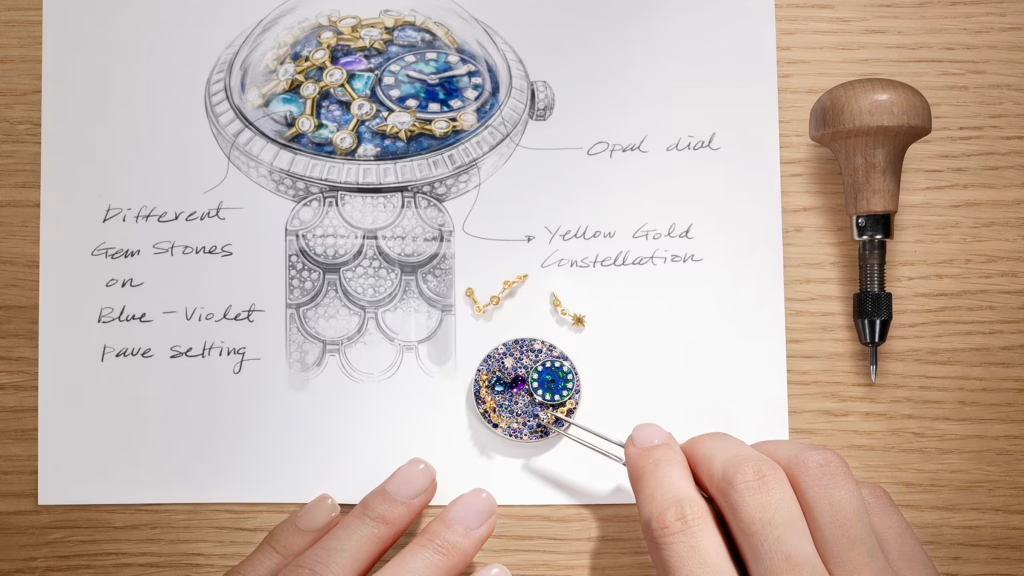
The Notte Stellata Divas’ Dream watch in white gold reproduces the star-filled sky that, according to legend, witnessed Rome’s founding in 753 BC. Its dial unites the shifting depths of a flying-saucer-cut black opal with a constellation of sapphires and snow-set diamonds, while thin yellow gold lines trace the astral map. Enclosed beneath a domed crystal — a poetic echo of Bvlgari’s iconic cabochon cut — the dial becomes a celestial painting. The flexible bracelet, featuring the fan-shaped Divas’ Dream motif drawn from the mosaics of the ancient Terme di Caracalla (whose restoration Bvlgari financed in 2015), wraps the wrist in a fluid embrace of light. The watch is powered by the new micro-movement Piccolissimo BVP 100.

The Pavone bracelet-watch celebrates the peacock — sacred to Juno, a recurring emblem in Roman art across centuries — transforming it into a jewelled creature of movement and volume. Diamonds, rubellites, and emeralds flow along the wrist in a choreography of light and colour, while the same Piccolissimo BVL 100 movement ensures that this sculptural creation also keeps time.
The Serpenti Dea Secret watch pushes the architectural expression of the Serpenti motif into new territory. Its newly conceived hexagonal bracelet wraps fluidly around the wrist, each link following the body’s natural curves. The serpent’s head, crowned with marquise-cut emeralds and penetrating emerald eyes, conceals a secret dial set with pavé diamonds — preserving the mystery of time within a masterwork of engineering and design.
A Method, Not a Moment
For the first time, a selection of Eclettica‘s one-of-a-kind high jewellery creations will remain on public display at the Bvlgari boutique at Via Montenapoleone 2, Milan, from 30 March to 19 April — a rare opportunity to experience these masterworks of Italian craftsmanship in person.
What distinguishes Eclettica from a merely ambitious high jewellery collection is the depth of its self-awareness. With this high jewellery collection, Bvlgari demonstrates to be a house recognising that eclecticism has been its animating principle since a Greek silversmith first set up shop in Rome 140 years ago. From Sotirio Bulgari’s early silver ornaments to the chromatic revolution of the 1950s, from the cultural omnivorousness of the 1970s to the sculptural daring of this latest collection, the thread is continuous. Eclecticism, for Bvlgari, has never been a style per se. It has always been a method — one that transforms contrast into harmony, and harmony into art that can be worn.
